Last Night Kim Deister Publication date: September 7th 2026 Genres: Adult, Psychological Thriller
What do you do when you keep losing time?
Terrifying visions torment Starra. Lost moments of time and flashes of images too horrific to accept fill her with icy fear so complete she can’t escape it. With too many unanswered questions, she needs answers. Now. It’s her only hope if she wants to save what’s left of her shattered mind and soul.
Unlike Starra, Mina cares nothing for her soul. Damned long ago, she’s too scarred for redemption. There are people meant to enjoy lives of love and family and friends. Mina isn’t one of these people. Her life is in the shadows, unafraid of the dark… until she realizes that something lurks in those shadows, something that wants to tear her apart.
Night fell quickly, swallowing the last light of day in the blink of an eye as the sky darkened from a surreal deep purple into a vast expanse of ebony. Not a single star pricked through the inky darkness. Even the moon shied away from shining too brightly through the clouds that faded into the night sky.
They call it the city that never sleeps for a reason. It was never truly dark in New York City, a million neon lights shining through even the blackest of nights.
But not tonight. Tonight the darkness engulfed everything it touched, dimming even the brightest of the neon, absorbing it into itself.
It was the kind of thick, cloying darkness that made people fear every shadow that moved as they hurried along the evening streets. It seemed alive, almost sentient, as it slipped around corners, like it was a predator chasing its prey, swallowing everything in its path into an endless void. People scurried along the sidewalks with their hearts racing, eyes furtively darting into the dark places. As the shadows shifted ominously, they quickened their paces until they were safely behind locked doors with the lights on and the curtains pulled tightly across the windows. They were right to hide, right to be afraid of whatever lurked on the other side of the too-thin glass. Dangerous things hid in the shadows of the night.
I knew that, probably more than anyone. The night scared the hell out of me. But it wasn’t the monsters that hid in the shadows that frightened me. They paled in comparison to the beast
I feared lurked within me, the beast that came out at night. I lived in fear that I was the monster that hid in the shadows.
Yet even as much as the night terrified me, I welcomed it. The darkness wrapped me in its arms. The shadows that danced on the walls didn’t scare me; they kept me company when I felt alone. The noises that made others slam their windows shut and throw the locks home sounded like music to me, distracting me from the thoughts that ran through my head all day long, tormenting me. The night energized me, made me feel strong and powerful when most of the time I felt anything but.
Author Bio:
My name is Kim and my last name, Deister, is pronounced “Die-ster.” I always tell my husband I should have kept my married name, Ingram. So much easier to to pronounce!
I am a writer thoroughly in love with words. Reading them, writing them… I love that words can take you outside of your world and let the unimaginable become imaginable. I love them so much that I decided I needed to create some worlds and stories of my own!
Besides being a writer, I am an Army veteran (and Army wife) and a mom to four sons. I grew up in northern New York in a tiny college town called Potsdam. Over the years, our Army life has taken us all over the place and I have been lucky enough to work and live in some pretty amazing places. Right now we live in Hawaii on the island of O’ahu, minutes from the North Shore.
The Last Summerville Annabelle Lewis Publication date: September 1st 2026 Genres: Adult, Psychological Thriller, Romance, Suspense, Thriller
Twenty-two-year-old Georgia Parker already carries more regret than most people twice her age. Practically an orphan, she’s reeling from the death of her grandmother, Mimi—the one person who made her feel safe from the chaos of her mother’s world. Alone in Carson City, Nevada, Georgia is determined to start over, to stand on her own. Yet Mimi’s final words echo in her mind: Take risks. Trust people again. Be brave.
Then Heath Summerville steps into her life—charming, magnetic, protective, and so perfectly attuned to her needs it feels like fate. But the closer Georgia gets, the more she feels the pull of something she can’t name—something just beneath the surface of his charm.
Strange silences. Half-truths. High-society circles and an ancestral house that feels more like a trap than a refuge.
Lies are waiting to unravel. And by the time Georgia sees the truth, it might already be too late.
“Get me out of this godforsaken town and back to civilization,” Vicky grumbled.
Georgia, behind the wheel, glanced at her mom, Vicky, who was shakily applying lipstick while looking in a handheld compact mirror. Vicky clicked it shut, then pulled down the passenger visor, only to find the old car devoid of a larger mirror. She swatted it back up, then garbled a sound of exasperation before diving back into her purse in search of something else.
Georgia didn’t see the lure of Las Vegas like her mother did. It was one of many differences between them. “No!” she suddenly exclaimed when Vicky put a cigarette to her lips, intending to light it. “Not in the car.”
“Why are you such an old damn scold, Georgia?” Vicky scowled. “You’re twenty-two years old, for fuck’s sake. Your holier-than-thou bullshit has gotten worse. Every time I see you.”
Vicky shook her head, then turned to stare out the window. Georgia swallowed back the words she wanted to throw in her mom’s face.
Not today. Not after all they’d been through.
They spent the rest of the drive to the Carson City airport in awkward silence. Georgia pulled to the curb at the departures area and then walked to the back of the Ford Bronco to help retrieve the bags. Vicky took them, mumbled goodbye, and walked away without a hug.
“Goodbye, Mom,” Georgia called loudly as she shivered in the cold, standing next to the back of her Mimi’s Bronco. She watched Vicky drag her bag, her head bowed, her eyes already on her phone. She didn’t turn to give Georgia one last look of goodbye, nor acknowledge Georgia’s use of the tender moniker of “mom,” rather than the usual “Vicky.” It hurt. But why Georgia expected Vicky to suddenly become maternal was the bigger question. And neither of them had made falsely loving or empty promises to keep in touch.
Author Bio:
Annabelle Lewis—a pseudonym for the author—lives in Minneapolis, Minnesota. Regrettably? Perhaps. She still believes she’s a Texan even though the math no longer supports that. Nor her birthplace. Nor her residence. No offense, Minnesota. You’ve got your good points too, but only about six months of the year.
In her youth, Annabelle was a complete failure. Ask anyone who knew her. Any of her teachers and family would tell you this. High school graduation was a sad day for all when Annabelle walked proudly off the high school stage, her thoughts consumed with boys, beer, and after-parties, and later into the arms of her parents. Her father’s laughter and singular remark? “I didn’t think you’d make it. Get a job at the post office, they have a good retirement plan.”
A high bar and words to live by, but Annabelle wanted more. She needed to flunk out of college too. But damn, she sure did have a good time. Trivial arrest records not-withstanding, it was a growth period for our girl. And if you look closely, you’ll see a bit of what was to come when she majored in criminal justice. Her lifelong aspiration was to become a judge. Hmm.
For better or worse, Annabelle didn’t graduate from college but did find gainful employment and a fulfilling career. This path ended when she became a mom. Married to her wonderful George, who to this day can hardly remember an actual proposal, Annabelle finally became a mother. She didn’t have a clue how hard she would need to work to keep those self-imposed requirements of Downey-fresh, iron-pressed sheets, home-baked meals, and mom-of-the-year awards arriving. She composed a small self-affirmation song and made her children sing it to her for money. She was a very good mom.
After clearing the largest hurdles of motherhood and regrettably, begrudgingly, and not-without-tears, launching her children onto the world, she looked around and realized she had a lot to say. Picking up a laptop, she got to work.
Annabelle spends her days continuing to tackle the challenges of motherhood, for both her humans and canines. She also writes. And reads. And cleans. And cooks. And bakes. And cleans again. She also supports her husband, George, in an administrative capacity for their small business. She’s in charge of payroll and cuts George’s checks. This leads to no marital acrimony.
In the beginning, with the blank page staring at her and possibly in a hostile mood after being literally mauled by a dog and by the world in general, she had an idea. What if she could wield a force of good upon unsuspecting evil-doers? What if she had the resources to get the job done without dealing with committee and anyone else’s whiney-ass opinions?
It was gold. It took off. Annabelle sat down and began to write and couldn’t stop. To date, having written over a million words in the Carrows Family Chronicles and her second series on the Boston Clairvoyants, several items have become quite clear. Annabelle had a lot to say. Annabelle really enjoys writing. And although she hates all things technology, she begrudgingly pounds her head on her desk daily as obstacles are thrown in her path. Almost a hero.
Since entering her world of make-believe, she has rebelled against all intrusion of real-world responsibilities. Her house is a mess, but she tries. Her family is fed, but more often than not, on takeout. She vows to shower every day, but no, it’s a vow she’ll never keep. Her friends are neglected, but not in her heart.
Read her mordacious blog! Read her books! Follow her on social platforms! Sign up for her newsletter! These are all good things. What are you waiting for? Jump into bed with Annabelle. She’s having a swell time. You should join her. theannabellelewis.com annabellelewisauthor@gmail.com IG and Twitter: alewisauthor
I want to welcome Gilly Macmillan to Books R Us. Gilly is the author of "The Burning Library." Thanks for stopping by.
About the Book:
A thrilling dark-academia tale of murder, obsession and ruthless ambition set in remote St Andrews, Scotland
On
a frigid, windswept day in Scotland’s Western Hebrides, Eleanor
Bruton’s body is discovered on the shore. To her family Eleanor was an
ordinary middle-aged woman. She made flower arrangements and plumped
kneeler cushions at church. Little did they know she was harboring a
dark and all-consuming secret: a scrap of fraying embroidery that seems
worthless at first glance.
For more than a century two rival
organizations of women have gone to deadly lengths to secure the
valuable artifact in the hopes of finding the original medieval
manuscript from which it was torn: The Order of St Katherine, devoted to
the belief that women must pull strings in the shadows to exercise
control. And the Fellowship of the Larks, determined to amass as many
overt positions of power for women as possible…so long as their methods
of doing so never come to light.
When Dr Anya Brown garners
international attention for her translation of the cryptic Folio 9, she
is handpicked by Diana Cornish, a professor and high-ranking member of
the Fellowship of the Larks, to join the exclusive Institute of
Manuscript Studies in St Andrews. Meanwhile at Scotland Yard, Detective
Clio Spicer begins a private investigation into the death of Eleanor
Bruton.
As all of them grow further entangled in this ancient
web, circumstances are spinning wildly out of control and their lives
may be in grave danger.
My Thoughts:
“The Burning Library” is a novel by an author new to me. The story is compelling and suspenseful, focusing on two secret women’s groups who have spent years searching for an artifact—a scrap of embroidery—that could lead them to The Book of Wonder, a manuscript said to grant control over society. With competing motives, each group vies for the prize, while Dr. Ana Brown, the protagonist, is drawn into the tangled mystery. I was immersed in a world of deceit, darkness, peril, murder, and memorable characters that enriched the plot. I give the book 5/5 stars.
About the Author:
Gilly Macmillan is the New
York Times & Sunday Times bestselling author of TO TELL YOU THE
TRUTH, THE NANNY, WHAT SHE KNEW (previously published as BURNT PAPER SKY
in some territories), THE PERFECT GIRL, ODD CHILD OUT & I KNOW YOU
KNOW.
Gilly is Edgar Award nominated and an ITW award finalist. Her books have been translated into over 20 languages.
She
grew up in Swindon, Wiltshire and also lived in Northern California.
She studied History of Art at Bristol University and the Courtauld
Institute of Art in London.
Gilly lives in Bristol, UK with her family and writes full time. She’s currently working on her seventh novel.
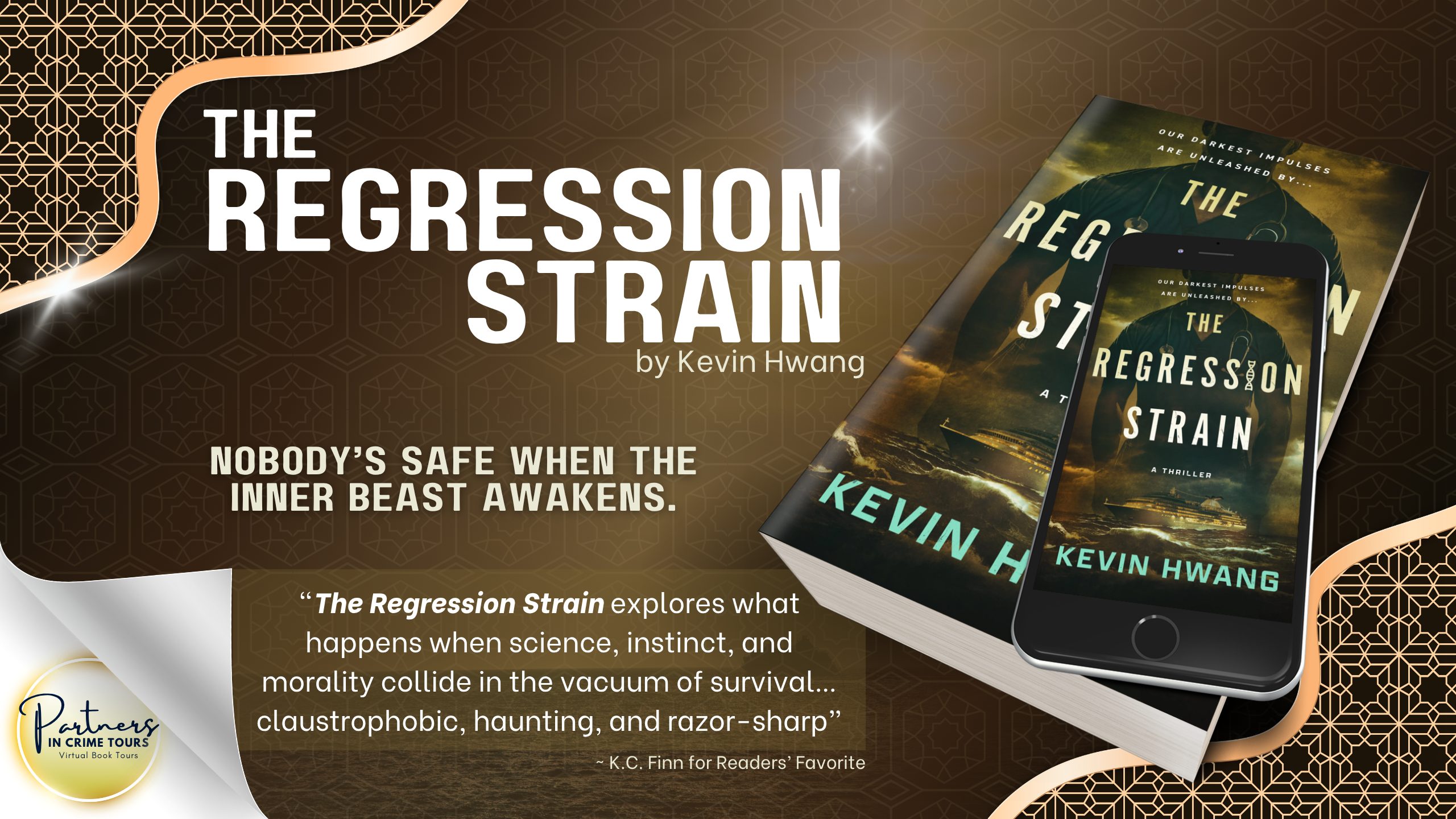
Dr. Peter Palma joins the medical team of the Paradise to treat passengers for minor ailments as the cruise ship sails across the Atlantic. But something foul is festering under the veneer of leisure. The brig fills with felons, the morgue with bodies, and the vacation becomes a nightmare.
Peter and his staff face a vile affliction that pits loved ones against each other and shatters the bonds of civil society.
With the ship hurtling towards an unprepared New York, only Peter can neutralize the threat, but he’s hallucinating and delirious.
And sometimes primal urges are impossible to resist.
Book Details:
Genre: Medical Thriller Published by: Normal Range Press Publication Date: May 21, 2025 Number of Pages: 344 ISBN: 9798992727012 (Pbk) Book Links:Amazon | KindleUnlimited | Goodreads | BookBub
Read an excerpt:
Chapter 1
The Regression Strain
As the cab rounded the corner behind the service buildings, the full bulk of the ship rose into view, a floating city gleaming white and blue against the gray Baltic sky. The Paradise would be Peter’s home and workplace for the next month.
His shoulders tightened. Had he forgotten to pack anything? It was too late now.
The taxi ejected him into the cool summer of Copenhagen—heaven compared to the stifling heat of Texas. He checked in at the terminal counter, cleared security, and joined the stream of chattering passengers traversing the covered gangway to board the vessel. Most of them spoke in English and a few in Spanish. Others conversed in German, French, or Scandinavian tongues. They seemed affluent and confident, not at all like his impoverished patients in Houston’s Fifth Ward. That guy in front—his Rolex probably cost more than Peter’s Outback.
Peter wheeled his suitcase through a colonnade of clapping crew members and across the threshold of the grand atrium. Its rich wood paneling and glittering chandeliers were as opulent as the brochures promised. He fused with the crush of passengers piling up in front of the diagrams posted near the elevators. Living quarters for the medical crew were on the lowest deck, conveniently adjacent to the clinic.
Amid the throng, a woman was fussing over a teenage boy in a wheelchair. She leaned in and whispered something in his ear, then tousled his thick mop of brown hair. With one hand cranked tight against his chest, he lolled his head back and rewarded her with a crooked smile. Her haggard face lit up. Now that was one tired mama.
“I like his shirt.” Peter pointed to the graphic of Thor wielding his massive hammer.
“You hear that, Calvin? He likes it.”
Calvin’s nose crinkled above the sparse stubble dotting his chin. She retrieved a ChapStick from her floral fanny pack and slathered Calvin’s lips first, then her own.
She offered the tube to Peter with a glistening smile. “Want some?”
He cringed. That was weird. “Uh, no thanks.”
“Want him?”
Peter’s eyes snapped up to hers. “Excuse me?”
“You can take him for a while.” She smiled and tipped her head. “He doesn’t eat much.”
“Ah…”
“Ha ha, it’s a joke.” She licked her moistened lips. “I’ve been on this boat too long. Cabin fever.” She gave him a little nod and wheeled the kid into the elevator.
The adjacent elevator dinged open, revealing a family that looked right at home, mom admiring the decor, two school kids horsing around. Sipping coffee in his striped polo, dad looked a bit like Peter’s microbiology professor—placid and plump.
Peter pulled his suitcase to the side with a smile. It was nice to see people relaxed and carefree. And if they needed medical attention—well, he could offer it. It would be a relief to simply treat patients. No rationing medications against their rent. No fighting through nettles of bureaucracy just to get a CT scan. He wasn’t built for that fight, and the last few rounds had left him bruised.
The younger child in the elevator darted out. Mom lunged and grabbed his collar, jostling dad into Peter. Coffee sloshed out of the man’s cup and down his jeans.
An animal snarl flashed over the man’s pale, doughy face. “Watch it, prick.”
“Sorry, I didn’t expect…”
The man leaned in, eyes glowing hot behind round bifocals.
Peter jerked back. “Whoa, are you okay?”
As the man cocked his fist back, Peter watched the sleeve of his polo shirt ride up his bicep, almost in slow motion. Peter quickly raised his open palms.
“Honey,” mom hissed. She tugged her little one back, and he huddled under her frail wings.
The man lowered his fist, the stench of coffee hot on his breath.
Peter nodded. “It was an accident. I’ll buy you another coffee. Or jeans.”
The heat in the man’s eyes dissipated and he blinked a few times, looking at Peter’s face yet his attention was directed elsewhere. “Ah, shoot.”
Sorry, mom mouthed and hustled the whole family away.
Peter stepped into the elevator among passengers who seemed oblivious to the encounter. His heart hammered in his chest, and his mouth soured with adrenaline. Microbiology professor? Scratch that—this guy was more like that assistant principal caught in a minivan with the high school girl. And here he’d nearly gotten into a fistfight on his first day.
But hey, he’d defused the situation. He was still supposed to be here. This was going to work out. He closed his eyes as the last passengers got off and the elevator continued to the bottom level.
The doors opened onto a hallway with plush burgundy carpet and polished handrails. Colorful abstract prints enlivened the walls. This was where everything could begin again, even at age thirty-two. He would be a healer on the high seas, applying his hard-earned expertise to help people on vacation.
But the aura disintegrated when he opened his cabin door. Inside was a single bed, a nightstand no larger than a magazine, and a built-in desk with a swivel chair. The sheets lay twisted in a lump at the foot of the bed, exposing a mattress with stains the color of dirty bathwater. A smudged TV hung crookedly from the ceiling, and a stale scent lingered in the air. The only feature that distinguished the cabin from a hospital on-call room was the round porthole window giving view to rusty shipping containers on the dock.
Well, he wasn’t on vacation, after all, even if everyone else was. Peter heaved his suitcase onto the lumpy mattress and began stowing his clothes. Luckily he’d packed light for this trial run. The tiny closet contained a white uniform, starched and waiting like a suit of armor, as well as an orange life vest and a safe the size of a cigar box.
The only real valuable he’d brought was his new 3M Littmann Cardiology IV, an upgrade from the battered stethoscope from residency. He fished around in the side compartment of the suitcase but came up empty. It should’ve been right there.
He checked every zippered pocket, then rummaged through his backpack. Nada. How could he have forgotten his freaking stethoscope, of all things? He’d followed his packing list. He loved lists, for heaven’s sake, loved checking off each item. Little good it had done. He drew a deep breath in then out, trying to clear his mind by counting to ten like the therapist said.
Ten seconds was a long time to think about nothing. Maybe he needed a higher dose of Lexapro. He’d been reluctant to accept his diagnosis, one he himself had given to so many patients, but the antidepressant seemed to help with his mood, concentration, and sleep.
The ambiance of the bathroom matched that of the bedroom, with black spots of mildew mottling the lower edge of the shower curtain. The sink offered little space for personal items.
He opened his bottle of Lexapro, shook a tablet into his palm, and swallowed it dry as he stared into the dingy mirror. Working aboard a cruise ship would be a huge change, and he needed to bring his best. He set the bottle on the narrow counter, but it clipped the edge, flipped out of his hand, and plopped into the toilet with an insulting splash.
His stomach clenched and he squeezed his eyes shut. Maybe, by some miracle, the bottle had landed upright with the tablets safe and dry inside, like a lifeboat. A tiny boat in a tiny toilet on a gargantuan ship.
He peered down. Nothing doing—the bottle floated on its side, surrounded by white tablets bobbing in the murky water like pearls of pasta in chicken broth. Why did the water have to look like that? Was it just reflecting the grimy inner surface of the toilet bowl?
Didn’t matter. His mental health was officially soaking in shit.
The half-life of Lexapro was around thirty hours, and he’d taken one yesterday back in Houston. He could just retrieve the tablets, wash them off, and dunk them in rubbing alcohol. Without more doses, the effects would diminish over the next few days. He could picture his exit interview: I’m sorry, Dr. Palma, you came ill-prepared.
One hand drifted to his pocket. At least he’d remembered to pack his favorite metallic pen. Even in the age of digital everything, a quality pen remained one of his favorite tools—that and old-fashioned index cards. His fingers closed around the pen, clicking the top: Ta-tick, ta-tack. Ta-tick, ta-tack.
Someone knocked on the door, but the bolt clicked open before he could reach it. The slight, olive-skinned man turned back to the hall almost as quickly as he’d come in. White shirt and charcoal vest—must be a steward.
“I’m sorry, I come back later,” he said with a duck of his bald head.
Peter waved him in. “It’s all right. I just got here.”
“Nobody clean your room yet?”
“I guess not.”
“You the doctor, no?”
“One of them.” He propped the door open for the man’s cart.
The steward glanced around the tiny room. “It will be my pleasure to serve you. I come later when you have gone out.”
Peter suspected the man’s cheerful acceptance hid the same bone-deep fatigue that had weighed down his own mother. She used to clean offices, back before Felipe joined the army, and she was always exhausted. Chemical fumes permeated her clothes and hair, and her knuckles cracked and bled until he bought her the non-latex gloves that her cheap-ass boss wouldn’t pay for.
Before Peter could return to the bathroom, somebody else came knocking: a petite woman in blue scrubs, probably late thirties. A tight ponytail held back her glossy chestnut hair. Her sharp cheekbones and jawline were all business.
“Luisa Calderone, nurse on staff.” The strength in her bony handshake matched the intensity of her hazel eyes. “They said this is your first gig.”
Yep, a fresh start, a sorely needed one. “Sorry. I’ll try to learn quick.”
“We can do a proper tour later, but let’s just walk and talk for now.” She nodded back at the hallway. “I can give you some time to get changed, but we have patients—so not too long, please.”
Right back into it, then. He was a kid on a roller coaster cresting the first big incline—the moment before the bottom fell out. He opened the closet and confronted his uniform. Sure, he’d paid for the ride, but that didn’t make it any less stomach-churning.
***
Excerpt from The Regression Strain by Kevin Hwang. Copyright 2025 by Kevin Hwang. Reproduced with permission from Kevin Hwang. All rights reserved.
MY THOUGHTS:
I thoroughly enjoyed "The Regression Strain." I was captivated from the very first chapter and finished the book quickly. Unlike some books that start slowly and make it challenging for me to stay engaged, this one was entirely different. The author crafted a thrilling story that combined elements of suspense, psychological drama, and mystery, all set within a realistic and engaging narrative filled with well-developed and interesting characters.
As a registered nurse, I was impressed by the accuracy of the medical procedures depicted in the story. It was clear that the author conducted extensive research and effectively integrated it into a compelling narrative. Each character had their own story to tell, and the protagonist, Peter, faced difficult decisions while trying to manage the outbreak. As someone who enjoys cruising, I sincerely hope never to experience such a situation firsthand. I give the book five stars. Excellent work, Mr. Hwang!
Author Bio:
Kevin O. Hwang, MD, is a professor of internal medicine at McGovern Medical School at UTHealth Houston where he sees patients and teaches residents. His academic work has appeared in leading medical journals. Nothing excites him more than chicken enchiladas, index cards, and appropriately sized packaging. The Regression Strain is his debut novel.
USA TODAY BESTSELLER • Perfect for fans of Alice Feeney,
Megan Miranda, and Tana French, R. K. Jackson’s lyrical, twisty
psychological thriller follows an aspiring journalist as she uncovers
dark truths in a seaswept Southern town—aided by a mysterious outcast
and pursued by a ruthless killer.
Now available for the first time as an audiobook, this lyrical novel
comes alive in a tour de force performance by narrator Hillary Huber.
When Martha Covington moves to Amberleen, Georgia, after her release
from a psychiatric ward, she thinks her breakdown is behind her. A small
town with a rich history, Amberleen feels like a fresh start. Taking a
summer internship with the local historical society, Martha is tasked
with gathering the stories of the Geechee residents of nearby Shell Heap
Island, the descendants of slaves who have lived by their own
traditions for the last three hundred years.
As Martha delves into her work, the voices she thought she left
behind start whispering again, and she begins to doubt her recovery.
When a grisly murder occurs, Martha finds herself at the center of a
perfect storm—and she’s the perfect suspect. Without a soul to vouch for
her innocence or her sanity, Martha disappears into the wilderness,
battling the pull of madness and struggling to piece together a
supernatural puzzle of age-old resentments, broken promises, and
cold-blooded murder. She finds an unexpected ally in a handsome young
man fighting his own battles. With his help, Martha journeys through a
terrifying labyrinth—to find the truth and clear her name, if she can
survive to tell the tale.
Audio clip from The Girl in the Maze a psychological thriller narrated by Hillary Huber:
Book Details:
Genre: Psychological Thriller Published by: Audiobook: Paradise Press in Association with Fright Night Audio; Print & eBook: Penguin Random House Audiobook Publication Date: August 5, 2025 Number of Print Pages: 300 Audiobook ISBN: 979-8-218-70529-9 eBook Links:Kindle | Goodreads | BN | Apple | Penguin Audiobook Links:Audible | BN | Apple | LibroFM | Chirp | AudiobooksNow | Spotify
GUEST POST:
Wait … I Wrote This? What It’s Like to Be Read by a Top-Tier Narrator
By R. K. Jackson
When I first wrote The Girl in the Maze, I never imagined I’d one day get to hear it performed by a narrator of Hillary Huber’s caliber. Just named one of AudioFile Magazine’s “Golden Voices” of 2025, Huber is one of the best in the industry. Her vocal performances have given life to hundreds of audiobooks, spanning thrillers, memoirs, literary fiction, and bestselling authors like Lisa Gardner and Nora Roberts. And now, lil’ ol’ me.
But what makes her truly remarkable, in my view, is her ability to inhabit character.
Her range is uncanny and her mastery of regional dialects was a particular asset for the novel, which is set on a barrier island off the coast of Georgia. Beyond her technical skills, she brings nuance, warmth, menace, and humor in all the right places. Listening to her narration felt like being reintroduced to my own book … and to the characters I thought I knew.
In the years since I wrote The Girl in the Maze, I haven’t spent much time rereading it—partly out of superstition, partly because I’m always working on the next thing. So, when I sat down to listen to the audiobook, it was with relatively fresh ears.
Some passages felt instantly familiar: ones I’d revised multiple times or read aloud at promotional events. But others? It was like someone else had written them. A stranger who happened to share my name. I found myself surprised—sometimes pleasantly, occasionally with a wince. (My inner editor remains armed and dangerous.)
Gummy Bears and Plot Twists
Even though The Girl in the Maze is an intense psychological thriller, I always knew it had flashes of humor—especially in the interactions between Martha, my high-functioning but deeply vulnerable protagonist, and her hallucinatory companion Lenny. But what I didn’t anticipate was how funny some of those moments would land when delivered by Huber.
One of my favorite examples comes during a particularly tense sequence. Martha has been shot in the leg. She’s lost in a Georgia marsh, dehydrated and delirious, when she encounters a fisherman named Loren Call, who’s clearly somewhere on the spectrum. What does he offer her? Not help. Not water.
Gummy bears.
When I wrote that scene, I was aiming for something creepy and absurd. But hearing Huber perform it, I couldn’t stop laughing. The whole Loren sequence plays out like a slapstick black comedy—Hitchcock by way of Flannery O’Connor.
I Got Emotional, Too
There’s a vulnerability to Martha that’s always been close to my heart. She’s brave and smart, yes, but she’s also haunted, fragile, and misjudged. Listening to Hillary voice her, I felt an almost parental protectiveness rise up in me. I knew exactly what was going to happen—I wrote it—but even so, I found myself sometimes holding my breath, worrying for her, rooting for her.
It reminded me of that famous story (perhaps apocryphal) about Stephen King watching the film adaptation of Misery. As the climactic scene unfolded, he supposedly yelled at the screen, “Watch out—she’s got a gun!”
Now I get it. When a great actor brings your characters to life, you don’t just remember what happens. You feel it again.
I Enjoyed the Book. Maybe for the First Time.
Writing a novel is a bit like building a ship in a bottle. You're so close to the glass, so focused on the fine (and sometimes tedious) details, that you rarely step back and just sail the thing. But listening to the audiobook gave me that rare chance to experience the book not as its creator, but as a member of the audience.
And to be honest, I enjoyed it a lot.
That’s not always a given for authors. We tend to be our own harshest critics. And don’t get me wrong, there were several moments when I cringed and wished I could go back and tweak certain passages. But for a few golden hours, I got swept up in the story. The mystery. The voices. The weird charm of a fictional island where the past and present collide.
I hope listeners will have a similar experience. Huber’s performance is truly something special, and I’m incredibly proud of the audiobook we’ve created together.
And hey—if you ever get lost in a marsh and someone offers you gummy bears? Maybe just keep walking.
Read an excerpt:
Prologue
She wants to kill you.
Martha’s fingers tightened onto the Pentel No. 2 pencil, clutched in
her lap like a secret talisman. Dr. Ellijay picked up the stack of test
booklets, squared them on her desk with soft raps, and began handing
them out. She walked slowly down the aisle, her heels popping on the
linoleum.
Not today, Martha thought. Please, Lenny, not today.
Outside the casement windows, the campus was awash in gray, a silent
movie, as it had been for days, suspended between fog and drizzle, the
dull light suppressing shadows, flattening the neo-Gothic buildings of
Ponce de Leon College like a plywood set. Only two o’clock, but outside
looked more like dusk.
The quad was empty, except for a lone figure seated on a bench, a man
in a tweed blazer taking notes in a composition book. He looked up in
Martha’s direction, then down at the notebook, then toward her again. To
escape his gaze, she looked elsewhere, beyond the campus buildings,
above the crenellated rooflines.
It was there again. She had seen it before, on bad days, and now it
stretched across the buildings, high above the spires and turrets,
gelatinous and nearly invisible except for a network of threadlike
capillaries. It pulsed and it heaved, breathing, alive.
Don’t look at it, Lovie. Lenny murmured in her ear, his voice moist and intimate. You know they don’t want you to see that, right? Just pretend you don’t see it.
Today Lenny was only a voice, but on some days she could see him. He
was tall and gaunt, his skin white and mottled, like the belly of a
toad. Spiked hair. Blue jeans shiny with stains. Canvas sneakers, gray
and frayed.
Martha felt a touch on her shoulder, jerked around.
“Relax, Martha.” Wade leaned forward in the desk behind her. “You look as tight as a piano wire. You’ll do great.”
You won’t do great. You’ll die. Lenny hissed. S’truth. You’ll die if you even touch the paper.
This was the first time Wade had spoken to her in months. In the
early weeks of the semester, he had flirted with her, singled her out
for special attention. For a while, the attraction had been mutual. She
liked his pug nose, his subversive sense of humor. But that was before.
Dr. Ellijay walked to the end of the next aisle, Martha’s aisle.
Have a look out, Lovie. ’Ere it comes.
Martha tried to concentrate, to review her mental notes. This was the final. Her grades had been floundering—that’s all part of the plan, innit?—but Martha had decided she would overcome the plan. She wouldn’t let them win.
Don’t touch the paper, Lenny rasped. It’s printed with
poison ink. It’s like them colorful frogs in Ecuador. We learned about
that in Biology 101, remember? Beautiful, but lethal. If you touch the
ink, you’ll die.
Dr. Ellijay returned to her desk at the front of the room and glanced
at her wristwatch. “All right, you have forty-five minutes,” she told
the class. “You may begin now. Good luck.”
Look at ’er. She’s watchin’ you. She wants to see you fail. Touch
the frog poison, and you’ll die. Look out the window. The man on the
bench, he’s watchin’, too. They’re all watchin’. They’ve all been
waitin’ for this moment, doncha see?
Martha stared at the page, paralyzed. She felt a drop of perspiration
release from her armpit and crawl down her side. Around her, she heard
the frantic scratching of her fellow students’ pens. They mingled with
the sounds of the rats in the walls, the ones that chewed at the masonry
with their sharp teeth, like yellow rice grains. The other students
acted as if the rats weren’t there.
She glanced at the clock. Six minutes gone already. She looked down
at the paper and tried to focus, to form the answers in her mind.
If you fall for it—don’t say I din’t warn you, Lovie.
She wanted to cry, or to scream, but she was motionless except for the pounding of her heart.
Don’t react. Don’t let ’em know. Don’t let ’em on to you, right? That’s the worst thing.
She heard Dr. Ellijay’s footsteps approach and stop next to her desk. She didn’t look up.
“Martha? It’s been ten minutes, and you haven’t even started. Are you all right?”
A swarm of ghostly, amoeba shapes floated in front of Martha’s eyes, and she felt as if her head would explode.
“Martha?” Dr. Ellijay placed a hand on her shoulder.
Martha screamed and lunged out of her seat, pushing the desk over, causing books to tumble out.
Run. It’s yer only chance—run like hellfire.
She bounded up the aisle, reached the door, and flung it open with a bang.
Run, Lovie.
In the hallway, Martha collided with a student on his cellphone,
texting. She turned the corner onto another hallway and spotted the door
to the custodial closet. She tried the knob. It opened. She slipped
inside, squeezed next to a plastic mop bucket with rubber wheels, pulled
the door closed, and slid to the floor.
In the darkness, she could smell ammonia. She heard the rats scurry
around her. One brushed against her ankle, another along the back of her
neck. Out in the hallway, footsteps approaching.
Voices calling her name. But Martha remained silent, invisible.
This is one thing we’re good at, hey, Lovie? Lenny said. We know how to vanish.
Chapter 1
Ten months later
Martha sat on an iron bench in front of the Wash-and-Fold and watched
a column of ants as they marched away carrying crumbs from the smashed
corner of a ham sandwich.
She had made the walk from the Pritchett House to Tobias Avenue in
only fifteen minutes, strolling past dew-damp lawns and sprinklers,
reaching the business district early. Nothing to do now but wait and
watch the town slowly wake up. The morning was hazy, already humid. The
rising sun painted sharp, expanding triangles of yellow on the buildings
and storefronts.
Martha opened her leather satchel and unfolded the advertisement, the
one Vince found on the bulletin board at the Gateway Center. She reread
it for the hundredth time.
EDITORIAL ASSISTANT
The Historical Society of Amberleen, Georgia, seeks a full-time intern
to assist with book project. Must be bright, organized, and
detail-oriented, able to hit the ground running. Will transcribe/edit
interviews, write introductions, assist with research. Three-month term
with stipend. Assist with book project. Must be bright, organized, and
detail-oriented, able to hit the ground running. Will transcribe/edit
interviews, write introductions, assist with research. Three-month term
with stipend.
She felt restless, considered moving to the local diner for a cup of
coffee, then scrapped the idea. Like so many things, caffeine was no
longer admissible.
She wished she’d brought a book to read, or maybe a newspaper.
Anything to take her mind off the fluttery feeling in her gut, a
sensation that took hold yesterday when the Trailways bus crossed the
Intracoastal Waterway and rolled past that sign in the grass median:
Welcome to Amberleen. Spacious Oaks, Friendly Folks.
Martha held the leather satchel close to her face and sniffed. The
smell calmed her. It reminded her of her father, who kept it bulging
with papers as he shuttled between their house and the university. She
tilted the satchel and heard a faint rattle from within, a secret sound.
The part of herself she would keep hidden.
A Lincoln Continental pulled up in front of the brick building across
the street and parked. A tall woman with white hair and an
old-fashioned, collared dress got out, unlocked the glass door to the
building, and entered. Martha checked her watch—eight fifteen. She took
out a mirror, freshened her lip gloss, and brushed a few strands of
loose hair from her face. It was time.
***
Excerpt from THE GIRL IN THE MAZE by R. K. Jackson. Copyright 2025 by R. K. Jackson. Reproduced with permission from R. K. Jackson. All rights reserved.
Author Bio:
R.K. Jackson is a former CNN journalist who now works at NASA’s Jet
Propulsion Laboratory. He is the author of two novels of psychological
suspense: the USA Today bestseller The Girl in the Maze and its sequel, Kiss of the Sun, both originally published by Penguin Random House.
What if one phone call could change your entire life?
With the page-turning suspense of Ava Strong’s FBI thriller Not Like He Seemed and gritty realism of Douglas and Olshaker’s New York Times Bestseller MindHunter, Whispers promises readers a nail-biting journey into the search for a serial killer and a window into the troubled mind of the agent who pursues him.
"They’re killing all the shrinks!" cries Nicola Kitts, now a special agent with the FBI’s storied Behavioral Assessment Unit. But why are prominent psychiatrists being targeted, and what secrets did they share?
In this sequel to Tears Are Only Water, Special Agent Kitts leads the hunt for a serial killer who leaves obscure mathematical formulas and twisted poems of retribution by the bodies. The FBI thinks they’ve figured it out, pointing to Raevyn Nevenmoore, a former gymnastic champion with a history of mania and delusions. But Raevyn hints that her twin brother Finch is involved in the killings. The only problem is, Finch died years earlier. Is Raevyn clinically insane or a clever psychopath? Haunted by her own traumas and hidden scars, Kitts struggles to piece together the clues and separate Raevyn’s madness from an even more troubling reality. Can she silence her own demons long enough to find the killer … and save herself?
Are you ready to uncover the truth? Dive into the chilling world of Whispers and experience a psychological thriller that intertwines madness, betrayal, and relentless suspense.
Grab your copy of Whispers today and join Special Agent Kitts in a race against time to piece together a puzzle that bridges the gap between madness and reality.
Praise for Whispers:
"J. Herman Kleiger’s new novel is equally gripping, moving along at a fast pace, as Kleiger’s sophisticated understanding of human psychology is on full display." ~ Richard M. Waugaman, M.D., Let’s Re-Vere the Works of Shakespeare
"An expert on the diagnosis and treatment of bipolar disorder as well as on the Rorschach test, J. Herman Kleiger is also a fiction writer, author of the acclaimed novels The 11th Inkblot and Tears Are Only Water. His riveting new novel, Whispers, is a psychological whodunit that will maintain the reader’s interest from beginning to end. Readers will learn much about bipolar disorder, post-traumatic stress disorder, conversion therapy, malignant parenting, and the lifelong impact of shame while trying to figure out the serial killer or killers responsible for the deaths of four psychiatrists. Just when readers believe that the diabolical murders have been solved, they are forced to think again. As with his other novels, Whispers instructs as it entertains, reminding readers that 'Hope is important for all of us who have walked in the shadows." ~ Jeffrey Berman, Distinguished Teaching Professor, University at Albany, and author of Clinical Fictions: Psychoanalytic Novels and Short Stories
"With Whispers, J. Herman Kleiger makes it a trifecta of his fine, psychologically astute novels. Picking up on several very interesting characters from his second book "Tears Are Only Water," as well as introducing a host of fascinating new ones, Kleiger takes us behind the scenes of the FBI Behavioral Science Unit delving into a series of confounding murders. The writing is taught and there are no easy answers in unravelling the mystery." ~ F. Barton Evans author of Harry Stack Sullivan (Marker of Modern Psychiatry)
"Kleiger’s third novel, Whispers, re-introduces us to Nicola Kitts, who we know well from his outstanding previous book, Tears Are Only Water. In this excellent new novel Kitts joins an elite FBI profiling team trying to solve a series of brutal murders of well known psychiatrists. Not a sequel, Whispers is a stand alone, gripping psychological drama that builds intensity and urgency as it flows inexorably towards its dramatic conclusion. With Kleiger’s deep knowledge of psychological theory, and interpersonal relationships, the book comes alive as the team of experts collaborate and compete to refine a workable theory about who the murderer might be, what might motivate him or her, and what hidden meaning the cryptic notes left at each crime scene might hold. We come to admire Kitt’s personal struggles and her ability to challenge her own demons even as she struggles to help solve these mysterious serial killings.." ~ Stephen Lerner, Filmmaker, Strangers in Town
Book Details:
Genre: Psychological Thriller, Mystery and Suspense, Serial Killer Crime Drama Published by: Indie Publication Date: May 5, 2025 Number of Pages: 270 ISBN: 978-1960299697 (pbk) Book Links:Amazon | Kindle Unlimited | Goodreads
Read an excerpt:
PART ONE
Comes the Whisperer
In the quiet of the night,
Silence prickles the skin and murmuring voices speak,
Telling stories in hushed tones of private lives and
Secrets buried so deeply that no one can hear,
Comes the Whisperer.
Tell me your secrets,
Speak to me of sin and shame,
And trust me with your soul.
—Anonymous
Chapter 1
They’re Killing All the Shrinks
The sirens were deafening, drowning out the heart-wrenching screams of frightened women and children. Around her lay the dead bodies of men from her platoon. Suddenly she was holding the limp body of her little brother Blue. The blaring sirens became the sound of her own scream. She awoke in a panic to the shrieking of her work phone.
Quickly orienting herself, she answered, “This is Kitts.”
“Wakey, wakey Kitts. Rise and shine. Hope you’re up. Doesn’t matter because we’ve got another dead shrink. It’s time to bring you in on this.”
Special Agent Nicola Kitts immediately recognized the brassy voice of her boss, Executive Assistant Director Giancarlo Bozzio Baldazzar. Boz headed the FBI’s Criminal, Cyber, Response, and Service Branch. Among his countless other jobs, he liked mentoring new agents. As a former Marine Captain, Boz had taken a shine to ex-gunnery sergeant Kitts. At 5’3,” he chewed out anyone who looked down when talking to him. Although he downplayed their Marine Corps connection, Kitts felt the strength of their invisible Semper Fi bond.
She glanced at her clock: 4:30 a.m. With a rush of adrenalin, she sat up straight and said, “Yes, Sir. Copy that.”
“Kitts, enough with the military, cop-speak bullshit. I’ve told you, we don’t talk like that around here. But listen . . . we’ve got another one. This makes three––Tamerlane, Fortunato, and now this guy in his Georgetown office. Same MO and signature as the others. Also left another calling card––the same wacky quote and a bunch of those crazy equations, like before. Looks like we have a serial killer who loves math as much as he does butchering shrinks. Anyway, this will be your first rodeo, kid. BAU-4 is staffing this in two days, so you have time to get up to speed. They’re a bunch of eggheaded profilers with egos to match, except for Sidd. He’s good people. So, Kitts, you’ll be there primarily to listen and learn. Their job is to profile. Yours is to keep a low profile.”
“You said this is just like the other two? Same MO?”
“Yeah, Kitts, that’s what I said. This last one was in DC. No suspects yet, but the local PD is working on this as a single homicide. They apparently don’t know about the others. The vic’s name is Linus Prokop. Maybe you’ve heard of him?”
“Yes, Sir. Isn’t he the guy on the cable news? I remember that name. Didn’t he do some kind of study on male adolescents?”
“That’s right. He’s a doozy. Been on the talk show circuit hawking his book about teenage boys and their hard-ons.”
Kitts smiled at his raw and uncensored expressions. Suddenly, she felt as if she were back in bootcamp with Boz as her drill sergeant.
“DC Metro is still working the crime scene. Probably won’t be too happy when we show up, but nothing new with that. So, get your rear in gear pronto and look at the files so you won’t seem like Doby the village idiot when you meet with BAU Number 4. Got it?”
“Copy––I mean yes, Boz Sir. I’ll be there by 7:00.”
“Make it 6:30. Oh, and Kitts, leave your damn bird at home this time. Now fuck off.”
She blushed as she remembered bringing Langston, her hyacinth macaw, to her office. He was not a hit since he wandered around, marked his territory, and chewed phone cords. Langston had been her sidekick for more than 15 years. If it hadn’t been for Langston, her old boss, Sheriff Oliver Burwinkle, would have killed her too after he shot an agent point blank in her living room.
Nicola microwaved a cup of day-old coffee while scarfing down a banana. She pulled Langston’s breakfast bowl out of the fridge, mixed in fresh fruit and vegetables, and topped it with large-shelled nuts.
The bird began to chatter and squawk to get her attention.
“Damn, cool it. Not in the mood this morning.” She noticed he was picking at the feathers on his chest again. “Stop picking at yourself. I ain’t got time for this shit now.” She reached for the spray the vet had given her and gave him a couple of squirts.
Kitts rummaged through a pile of clothes on her chair and grabbed a wrinkled jacket from the floor. Life had been this way since moving to DC two years ago.
“Alexa, play some . . . Tracie Chapman music. No, cancel that. Play––”
Alexa cut her off and said, “Here is some music by Tracie Chapman on Amazon Music.”
“Dammit, girl. Alexa, cancel that. Play music by Libba Cotton and turn up the volume by two.” She felt there was something enchanting about Cotton, an obscure left-handed folk and blues musician who taught herself to play upside down on a right-handed guitar. That Cotton didn’t begin recording until her 60s and won a Grammy at age 90 gave Kitts hope that people could successfully reinvent themselves in midlife.
She turned on the shower as Libba sang Ain’t Got No Honey Baby Now. The water was cold, but she didn’t have time for it to warm up. The chill jolted her senses. She threw on her clothes and hurried past Langston––still picking his chest feathers. “Langs! Stop that shit! I gotta cruise now. Won’t be back until dark ’cause this is a big one. You got plenty to eat, so be cool and STOP doing that to yourself.”
The thought of another dead therapist put her on full alert, especially with this last one being so close to home. On the way out the door, she stopped and reached out to Langston. “Damn boy, it looks like they’re killing all the shrinks…. Betcha, you’re glad I left shrink school, huh?”
***
It was still dark when she exited onto South Washington St. She opened the window, welcoming the chill of cool air on her face. She tried to focus on the killing of yet another psychiatrist, but the hangover from her nightmare was still taunting her. Her VA counselor told her that dreams about the war would never disappear entirely. He said she could learn to reprocess them to make them less frequent, vivid, and painful, but they would never disappear. Fucking nightmares.
In the darkness, surrounded by the hum of the tires, Kitts thought about the regular cast of characters who haunted her sleep. Her dreams were typically set in Afghanistan where her brother Blue, Burwinkle, or Pei would suddenly appear, always trying to speak to her in muffled voices. Desperate, she couldn’t move. Her counselors told her she’d be dealing with the long reach of PTSD for the rest of her life. She should expect early and subsequent losses to merge with nightmares of her final bloody firefight in the Musa Qala District.
At times, she dreamed only of Blue and his death when they were kids. No matter how much Nicola tried to come to terms with what happened, the guilt never wore off. Paradoxically, there was something oddly comforting about her nighttime visits from Blue, as if he were trying to tell her something.
She hated how the traitorous bastard Oliver Burwinkle forced himself into her dreams. Her former boss and mentor back in Colorado continued to stalk her in her sleep after his final deceit. Now, Professor Omar Pei had become the latest cast member to appear uninvited in her dreams, whispering lustfully to her about their forbidden affair at Smith College.
Kitts checked her speed as a highway patrolman passed her on the right. Cops. The cruiser reminded her of the Ford Interceptor she used to drive when she was the only deputy of color in the sheriff’s department in Colorado. She left law enforcement in 2014 after Burwinkle tried to kill her. Nicola’s stomach churned when she thought of the impostor. Burwinkle turned out to be a serious bad guy. Fortunately, thanks to Langston’s attacking him, Burwinkle dropped dead of a heart attack before pulling the trigger of the gun he had aimed at her head. Fucking Burwinkle.
Though she had long thought about leaving police work, the catastrophic events of 2014 and her subsequent treatment at the VA convinced her it was time to make a clean break and try something new, like becoming a social worker. Her decision to leave law enforcement always made her think of her quirky friend Carmine or “Books” as she called him. Nicola still felt embarrassed by his generous financial gift, which made it possible for her to go to Smith College of Social Work. She recalled their awkward conversation five years ago when she received a check from an anonymous donor that covered her tuition at Smith.
“I know it was you, Books. You’re always up to something sneaky like this. I will pay you back. Got that? Been saving up my money.”
But she hadn’t paid him back.
She had been a rising star at Smith, earning her MSW in just under two years. Nicola had begun working on a PhD when she suddenly became the headliner in the campus rumor mill. She mistakenly thought her involvement with one of her professors was a private affair.
Thoughts about Pei always reminded Kitts of her misplaced trust in Burwinkle whose words she couldn’t forget.
“Goddammit, Cole. You were like a daughter to me, girl.”
Then he tried to kill her.
The relationship with Professor Omar Pei began innocently enough. He was struck by her intelligence, fascinating resume, dogged curiosity, and innate insight, and mentioned in passing her striking good looks.
Looking her up and down, he’d intoned, “You’re special Nicola Kitts. I’ve had my eye on you. You have the intellectual gifts and instincts that most students can only dream of. I’ve taken a special interest in your academic development. Dine with me tonight so we can discuss your thesis.”
And she did.
Kitts’s internal signals told her she was straying into dangerous territory, but she ignored the warning lights. It felt good to be special.
Man, gotta figure out this shit with mentors, girl.
Their affair lasted less than three months but unleashed the hungry tabloid hounds within the small college community. Ultimately, the professor was dismissed, and his student branded with a scarlet letter. It didn’t matter that no one formally blamed Nicola for her mammoth lapse in judgment. She heard the whispers and saw the looks wherever she went. It became too much to bear. One morning, she decided she’d had enough. She packed everything that would fit into her car and left with Langston.
Nicola knew that even before the Pei affair, she’d been questioning whether social work was her true calling. Maybe her embarrassment at Smith was just an excuse to leave social work. Part of her wanted to be done with policing but it wasn’t done with her. Law enforcement was in her DNA. Her father and gramps had been Marines and then cops in the Wichita PD. Having no desire to return to the sheriff’s department in Colorado, Kitts applied and was accepted to the FBI Academy.
The traffic was light. Can’t keep Boz waiting. The final stretch of Richmond Highway reminded her of how she felt the first time she drove to Quantico. She had been filled with hopes about combining law enforcement with her curiosity about the workings of the mind. Even then, she aspired to someday become a profiler.
After completing the FBI Academy, Kitts worked as a junior agent before snagging an appointment to the BAU (Behavioral Assessment Unit). Only a year into her role as a special agent, Kitts felt she’d found a home where she could pursue criminals and discover the deep-seated pathologies that had turned them into killers and predators. She knew about the storied BAU-4 and its predecessor, the FBI’s Elite Serial Crime Unit, popularized in one of her favorite books, Mindhunter. That someone at Boz’s level would select her to shadow this celebrated team of profilers and analysts was a pulse-quickening honor. She thought of his words several months back.
“Kitts, I’ve been watching you. I think you got what it takes to work with the BAU. When the time is right, I’m going to bring you in. I got faith in you. Just don’t try to act too much like a cop.”
Kitts checked her watch as she flashed her ID to the Marine at the gate. Six twenty-seven––three minutes to spare. She sprinted to the building; Boz would be watching the clock. Kitts wanted to impress him but knew he would quickly pick up her efforts to curry favor. Boz had apparently seen something in her that she was not aware of. But hadn’t Burwinkle and Pei? She was grateful that Boz was giving her a chance but determined not to make the same mistakes as before. All she needed to do was trust his judgment and not lose sight of hers. Just be yourself, whoever that is, and steer clear of whatever’s going on with mentors. She speed-walked into his office and reminded herself not to speak like a cop and never look down at the top of his head.
***
Excerpt from Whispers by J. Herman Kleiger. Copyright 2025 by J. Herman Kleiger. Reproduced with permission from J. Herman Kleiger. All rights reserved.
Author Bio:
J. Herman Kleiger (Dr. James H. Kleiger) is a board certified clinical psychologist and trained psychoanalyst living in Maryland. Born and raised in Colorado, he received a BA from Harvard University and a doctorate in clinical psychology from the University of Denver. He served as a staff psychologist in the Navy and received postdoctoral training at the Menninger Clinic in Topeka, KS, where he became Training Director of the Postdoctoral Fellowship Program. He completed his psychoanalytic training at the Topeka Institute for Psychoanalysis and later relocated to Maryland. Dr. Kleiger opened a private practice and served as President of the Washington-Baltimore Society for Psychoanalysis in 2010. He lives with his wife and is blessed with wonderful children and grandchildren.
Writing about people and their struggles has been integral to his professional life. Dr. Kleiger has authored six professional books – Disordered Thinking and The Rorschach, 1999, followed by Assessing Psychosis, 2015, 2024 (coauthored with Ali Khadivi), Rorschach Assessment of Psychotic Phenomena, 2017, Psychological Assessment of Disordered Thinking & Perception, 2021, and Psychological Assessment of Bipolar Spectrum Disorders, 2023 (coedited with Irving Weiner).
Unable to resist the play of imagination, J. Herman Kleiger published his debut novel, The 11th Inkblot in 2020, followed by Tears Are Only Water in 2023, and Whispers in 2025.
People and their stories amaze and inspire. As a psychologist and psychoanalyst, his passion for listening to people tell their stories ripens with time.





 Twenty-two-year-old Georgia Parker already carries more regret than most people twice her age. Practically an orphan, she’s reeling from the death of her grandmother, Mimi—the one person who made her feel safe from the chaos of her mother’s world. Alone in Carson City, Nevada, Georgia is determined to start over, to stand on her own. Yet Mimi’s final words echo in her mind: Take risks. Trust people again. Be brave.